
Wilderness · Garden Route · South Africa
The extreme
is possible.
“Whenever you are in the presence of your horse, you are essentially communicating — whether it is your intention or not.” A science-based education in horse–human communication, from the Garden Route, South Africa. Helping People, Helping Horses.
The question
How can horses overcome their deepest instinct in the most extreme situations — while others struggle where there is no threat at all?
Lions and elephants awaken the strongest instinct a horse has. Yet well-trained safari horses are capable of overcoming it — calmly, in the most extreme situations on earth. Not any horse, and not by luck: every horse in that herd is trained, and it is the well-trained lead horse who reads the wild animal and mediates the encounter for the horses behind him. Meanwhile horses in safe, domesticated environments — yards, arenas, trails — struggle to manage and navigate spaces where no real threat exists. The missing link? Communication and education. And when that education is clear enough, horse and human stop bracing against one another and settle into flow — nothing mystical, just two nervous systems in an optimal state.
So — what is the extreme?
A horse calm enough to stand eye to eye with the wild.
The essence
A human asks a question.
A horse answers with movement.
Dressage or trail. Groundwork or liberty. Jumping, safari, or a horse standing quietly to be shod. Strip the discipline away and this is all that is ever happening — a question asked, and an answer given through the feet, the body, the breath.
Which is why this is not a style, or a brand, or somebody's method. It is the mechanism underneath all of them. Learn to ask clearly, and every discipline you will ever ride gets easier.
The principles
Two dimensions.
One state of flow.
In Communicate With Your Horse, Ray simplifies that conversation into principles across two dimensions — the psychological and the physical. It is not a method that replaces what your horse already knows: it amplifies any good training, in any discipline. The goal is always to move towards flow — “nothing mystical, just two nervous systems experiencing an optimal state of consciousness.”
01 The Psychological Dimension
How your horse experiences the world — and how your mind shapes the conversation.
Empathy & Umwelt · Intentions · Attention · Goals · Embracing Struggle · Creativity
02 The Physical Dimension
What the body says, and how to answer it — pressure, posture, timing and feel.
Active & Passive · Release · Rest & Digest · Softness · Confidence · Control & Influence · Directional · Energy

Wilderness, Garden Route — where the method lives

First edition · available in print & Kindle
The book
Communicate With
Your Horse.
Simplifying principles for effective communication with horses. Written from Ray's years of dangerous encounters with lions, elephants and black rhino on foot and from horseback — and proven on ordinary yards, working through trauma, aggression, dominance, mistrust and fear of humans.
“We are essentially training our horses every time we are in their presence.”
— Rynhardt Erasmus, Communicate With Your Horse
Work with us
From your yard
to the wilderness.
Every service runs on the same engine — the nervous system — whether we're training your grooms, your horse, or you.
Ray works out of Wilderness on the Garden Route and travels to yards across the Western Cape. Most of it starts the same way — he comes to you, watches the horse you actually have, and tells you plainly what he sees. Hoof care and training are done by the same person on the same visit, which matters more than it sounds: a horse who moves badly is very often a horse who is landing badly.

Grooms Training
Your grooms shape your horses every day — train them to keep every horse calmer, safer and happier.

Online Academy
The complete Horse Flow method — from body language to advanced training — wherever you are in the world.

Group Clinics
Gather your yard and we come to you — hands-on 2–3 day clinics anywhere in the Western Cape.

Individual Clinics
Not on the Garden Route? With enough interest we bring focused, science-based training to your region.

Garden Route Farriery
Science-led, balanced hoof care that treats the whole horse — with a plan built around their needs.

Private Sessions
Learn to read your horse's nervous system and keep them calm and willing — even when it counts most.
“Nothing mystical — just two nervous systems experiencing an optimal state of consciousness.”
Ray Erasmus · Founder
Where it was learned
Step into
the bush.
These are real moments from Ray's guiding years — lion, elephant, rhino and hippo, met from the saddle. This is where calm was learned.

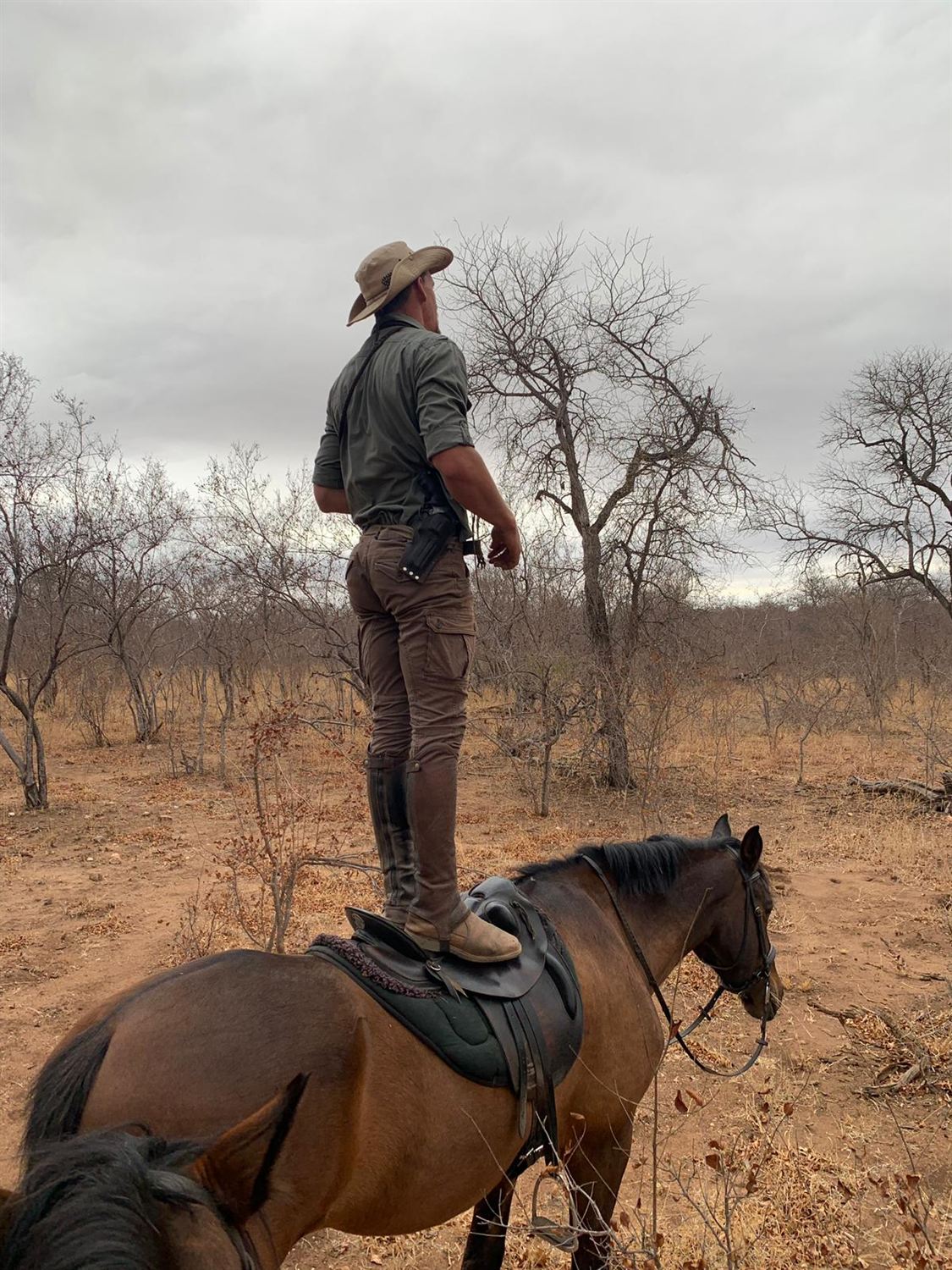
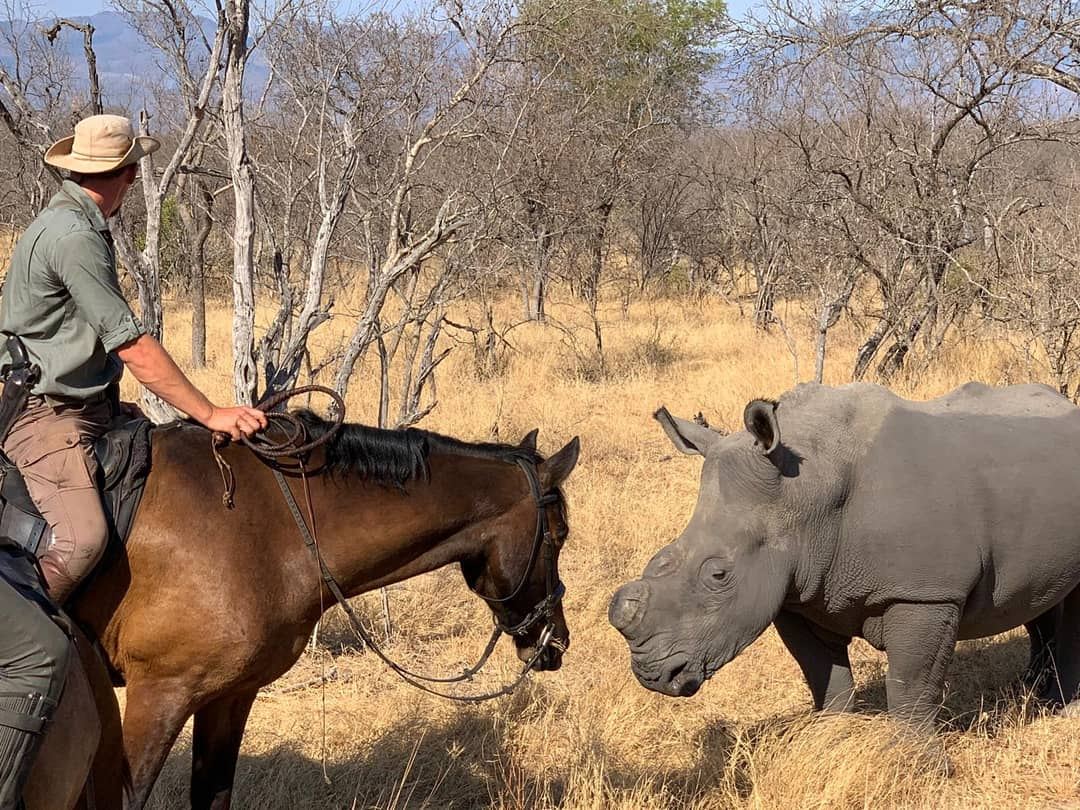


Drag, or use the arrows — and step into the bush.
The Compass Assessment Tools
Every journey starts with
an honest bearing.
Ray built the Compass to answer the question every owner asks: “where do we actually stand — and what should we work on first?”
There are now seven of them — one for the horse you actually ride. Foundation, Dressage, Showjumping, Cross-Country, Eventing, Western and Trail & Terrain. Every discipline tool includes the Foundation Compass, and you only ever see the one you ride.
Choose your compass Try the free reading
Or take the free walk-only reading right here — twelve questions, about three minutes.
The Horse Flow Compass
Where are you and your horse, really?
Your horse stands in the middle of his own compass. He should be able to move forwards, backwards, sideways and diagonally — at any energy, in any gait — and do each of those three ways: softly, willingly, reliably. This free reading keeps it to the walk — head and neck, shoulders and hindquarters. Twelve honest statements. Three minutes. The Compass shows you which direction is missing, and which of the three is letting it down.
Find your headingYour heading
Keep this reading
We will email it to you, so you have it in the barn — and so you can compare it with the next one.
This is the free mini Compass — walk only, twelve questions. The full Compass Assessment Tools are the framework Ray uses on client yards: seven of them, one for the horse you actually ride — Foundation, Dressage, Showjumping, Cross-Country, Eventing, Western and Trail & Terrain. Every discipline tool includes the Foundation Compass, saves a chart for each of your horses, and hands you your next job in order.
The online academy
Learn it anywhere.
Practice it with your horse.
A clear path you follow at your own pace — the same progression Ray teaches on the Garden Route, wherever you and your horse live.
Step one · the why
Philosophy & Theory
The two dimensions of communication from the book — how your horse experiences the world, and how his body answers. The thinking behind everything. Start here.
In production
Step two · the how
Foundation Education
Where it comes alive. Direct the feet in every direction, at every energy and gait — soft, willing, reliable. This sets you up for almost anything.
In production
Step three · refinement
Advanced Education
Once the foundation is solid, take it as far as you both want to go — on the same compass.
In production
Plus standalone courses — Liberty, Trail Riding, and how to use the Compass. Foundation and Advanced both come out of the Compass itself.
20+
Years with horses
10,000+
Hours in big-five country — on foot, on horseback, and in vehicle
100s
of horses helped
1
Published book — more coming

Who's behind it
Rynhardt “Ray” Erasmus
Trainer, farrier, Big Five safari guide, and author of Communicate With Your Horse. Twenty-plus years across South Africa and Botswana taught Ray one thing above all: horses are honest — the question is whether we are readable.
The principles draw their lineage from Xenophon to Dr Andrew McLean's equitation science, Jaak Panksepp's affective neuroscience, flow psychology, and Yogi Sharp's hoof biomechanics.
Students
In their words.
Helping People,
Helping Horses.
Whether it's one horse, one lesson, or your whole yard — start the conversation.
071 611 0734 · horseflowacademy@gmail.com · Wilderness, Garden Route